Friday, August 25, 2006

Paul West

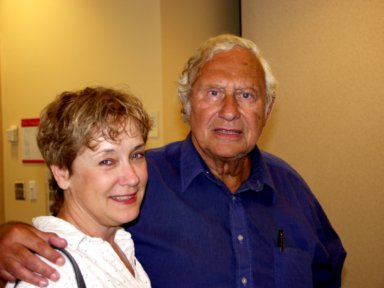
Paul West and Jeanne Mackin at a reading at the Tompkins County Library,Ithaca, NY, in the fall of 2005. Article and photo by Stephen Poleskie

LAST WEEK I SPOKE to Paul West on the telephone. We had not been in touch for some weeks, then I received a letter from him in the mail. My wife, Jeanne Mackin, and I used to meet with Paul, and Diane Ackerman, every Sunday for brunch at the Sangam Indian Restaurant in Collegetown. However, since his stroke, the second he has had, and his subsequent development of Broca's Aphasia, we have only met once since his return from Florida, where he now spends the winters. I must say that I miss our regular meetings, which were always quite witty, and sometimes rowdy.

Broca's Aphasia affects ones ability to speak and understand language. Paul does have a brief time, during the middle of the day, when he is not afflicted by this malady. Otherwise, usually after about three o'clock he does what he calls "zoning out." I was reluctant to call, as I know Paul tries to work during his "clear time," but he doesn't use a computer, preferring an the old fashioned typewriter, so doesn't answer e-mail.

Paul sounded happy to hear from me. He has been busy since his stroke and has written three books: Tea With Osiris, a book of poems, The Shadow Factory, a prose meditation on the effects of his illness, and a 700 page, as yet untitled, novel. This two year output would be staggering for any author, but Paul has always been productive, having in the past written over forty books, and numerous short stories, articles, essays, and book reviews. The poetry book has recently been published by Lumen Books, and excerpts from it appear below. The prose work will be available from the same publisher in 2007.

SP

from TEA WITH OSIRIS

  Back in the hospital a child
      of twelve is screaming, felled
      by loss: Where is she?
      They hold her close, then down.
      Osiris added her to his own.
      And the foam from her squandered lip
      will take its place among famed
      vapors from cuckoo to Lear, aimed
      at school children out on a trip,
      from Emily Bronte's poisoned menses
      to Eva Braun's best pensées.
      All grist for the Osiris mill,
      which says, whatever you will,
      you shall please me till I kill.

*************************

One summer's day in winter
      when the snow was raining fast,
      a barefooted boy with clogs on
      stood sitting on the grass.
      He went to the movies that night
      and bought two front seats at the back,
      ate a big plain cake with currents in,
      and when he'd eaten it he gave it back.

**********************************

A review of Paul's book, written by Bridget Meeds, appears in the August 23, 2006 issue of the Ithaca Times. Here is a brief excerpt from this review: 

TEA WITH OSIRIS IS a book of poetry, only the third West has ever written. It is a dizzying 53-page sequence of sonnets about Osiris, the Egyptian god of the dead, as he swans about a modern American hospital with a kidney stone "somewhat smaller than / that blocking Christ entombed," waiting for the awful nugget to pass. By turns ribald and funny, morbid and clever, West is as intelligent and language-drunk as ever. Osiris is, as he writes, "As fully languaged as Pan / with constant updates from the constabulary / of vocabulary..."
      But the voice here is much more compressed than in his novels, which tend to sprawl. In this book, West is compelled to say more with fewer words.
      Sonnets such as (those printed above) don't shy away from truth.

Tea With Osiris, poems by Paul West, Lumen Books, 116 pages, $17.00, hardcover.

                                                 ***********************

Thank you for logging on. Please check back again. We accept submissions at OnagerEditions@aol.com.

Sidney Grayling, Editor


Friday, August 11, 2006

FISHKILL


a short story by


Stephen Poleskie


The telephone rings, interrupting our dinner, the tense, jarring sound phones make when you are waiting for a message; perhaps word that someone close has died.

"Hello! How's your father doing?" "Hello! Who's this?"

"John . . . ."

"John?"

"I'm at my nephew's house. We went fishing .... "

"Dad's still in intensive care . .  . " I say, in answer to John's question that he had not asked.

There is a long pause, John considering whether to go on, his earlier tone indicating he was expecting to hear good news.

"Tell your Mom that I have some fish for her . . . trout . . . just caught.

All she has to do is clean them. I'm bringing them right over." John says, and then hangs up.

I have no chance to protest, nor to ask my mother if she even


wants some fresh fish delivered right now.

We hurry to finish our dessert, two portions of homemade apple pie. There is none left to serve to John, who loves my mother's apple pie, if he should arrive while we are eating our pieces, and the first bites we have already taken from these slices have made them unofferable.

Arriving at the back stairs almost immediately, John shouts: "Hello!

I brought the fish."

I walk out on the back porch to greet him, but my eyes do not meet his, rather they are drawn to the bucket of squirming, green and silver and brown, mustached and scaled creatures, swimming in more of their own kind than water, what little there is of it turned pink by fluids that must have once been inside the fish themselves.

The widow woman from next door, also telephoned from his nephew's house, and who is considering the possibility of the never married John, arrives at my mother's back steps with her knife. The three begin in earnest: decapitating, splitting, gutting, then laying the pieces out on the concrete stairs. Severed, the fish heads wink their eyes, and open and close their mouths, a gesture that must have been what got them here in the first place. Then, they shut up forever.

"Fresh!" John says, holding up the streamlined creature wiggling in his hand, its intuitive grasping at life to be taken as proof of his statement. "I caught them just this morning at Slocum Bottom. They were running ... just jumping on my line. I was using leaches . . . they like leaches."

"Get a knife from the kitchen, Son," my mother says, turning to me, "John will show you how to clean fish."


Several tails on the pile of discarded pieces still flap, obeying motor commands sent by brains that now lie in a separate heap.

I go inside, as if to get a knife, but do not come back out.

Eight plastic bags dripping fluids, six machines pulsating with multicolored digital readouts that monitor his every puff and beat, and finally cutting away more than half of his insides, keeps my father alive for another three weeks; then the huffing and burbling, and beeping and wheezing stops.

John, no relation, but a close friend of my father, gets to ride in the limousine, all the real relations being either too far away or already dead.

"Jeez, this is a great car!" says John on the way to the church, never having ridden in a Cadillac before.

"Jeez, this is a great car!" says John on the way to the cemetery.

He has never wanted an automobile before, content to walk wherever he needs to go in our small town, but a Cadillac is different.

"I'm getting old," John says, "I shouldn't have to walk up and down these hills every day." He does not realize that it is probably because of these daily walks that he has reached his fine old age.

"I could use a Cadillac to go fishing," John tells us, "and not have to wait for my nephew to take me . . . he works and can only go on Saturdays. Do you know how much a Cadillac costs . . . I mean a good used one? I couldn’t afford a new one. I would think that people who owned Cadillacs keep them in pretty good condition, wouldn’t you?”

“I suppose so,” I reply. 

For the remainder of the funeral, John talks only of his future Cadillac; thereby avoiding the grief my mother and I are experiencing.


*****************************************************************************

Stephen Poleskie is an artist and writer. His work is in the collections of the Metropolitan Museum and the Museum of Modern Art, among others. His novel The Balloonist is forthcoming from Frederic C. Beil, Publisher in January of 2007.

******************************************************************************

Thank you for logging on. Please check back again.


Monday, August 7, 2006

The Color of Time

an essay by

Jeanne Mackin

The years like great black oxen tread
the world 
    William Butler Yeats

MINE WAS A CHILDHOOD of seasons, and each season had its own special color. Spring was green with grass and blue for robins eggs found broken in the dirt next to the rosebush; summer was gold with heat and shimmering dust and brown faded lakeweeds left drying on the shore; fall of course was red and orange with dying leaves that matched the ochres of new pencils and book covers; winter was red and white, the colors of impatience, of waiting for the gifts to be placed under the tree and waiting for the moment when those gifts could be opened.

I learned the colors of time early and thoroughly, learned to mark the year and the seasons and the days by their colorful tags, the pink and blue icing of birthdays cakes, the purples and yellows of Easter eggs. Color and time became inseparable, perhaps because my father is color blind and I spent much time trying to "see" the world as he must, as a place of contrast and movement and even a primary color or two but without the subtlety of hue and tint. I learned to use color as efficiently as any watch or calendar and can still tell the time within a half hour or so simply by looking for clues in the way sun hits lilac leaves or tints the clouds. (Don't test me on this. I don't perform well under pressure.)

We tend to think of time as the great invisible. It is friend and foe, lover and for a few brief months when we are so new we can't recognize even a clock's ticking, it is a stranger. Time is omnipresent and, ultimately, omnipowerful. Yet we cannot see or smell or touch this shadow of eternity, winged chariot, great leveler, robber, unmasker of falsehood, this kindly god...or so goes the litany of names given time by poets and philosophers.

Yet we have learned to measure this great invisible, to mark it, to celebrate, to mourn it. We have named it for its duration as moment, minute, hour, day,week, month, season, year, decade, century, era, millennia...eternity. (Time, in old Irish, begins with a word that translates only as "in the blinking of an eye."). We have tried to make time visible by tagging it the way scientists tag butterflies and sperm whales. We have discovered time, measured time, tried to control it by assigning shores and paths as if it were a river we could chart and even dam. We have tried to make the ethereal tangible, even tried to be on a first-name basis with it.

But as well as naming time with an avidity matched only by Adam's urge to name the beasts who shared his Eden, we have colored time. Like children with crayons, we have filled in the outlines of the great invisible and assigned to it portions of the rainbow, that fraction of time between storm and stillness when moisture prisms sun into the never-reached goal of fortune seekers. We talk of green youth and gray age, of rosy dawn and violet dusk, of blue days and silver anniversaries, of black hours and golden eras. We mark the holidays of the year with color, and the different ages of history and its events with color.

For instance, the new millennium is going to be a blue one, according to astrological lore. Blue, the color of both air and water, the color of melancholy and of many spring wildflowers, the color of this planet when seen from outer space, is the astrologically assigned color for the next Great Month, the Age of Aquarius, which began New Year' Eve, 1999. Perhaps the blue of the Aquarian Great Month now beginning reflects the inevitable journey of earth dwellers from closed dark cave to infinite unknown space. Or perhaps the Age of Aquarius will be marked by manic depression on a universal scale.

All Great Months have their own color: the age of Pisces, begun when Christ was born, was sea-green, an appropriate color for an era marked largely by a religion whose foremost symbol was that of the fish. The Great Month of the Pharaohs, also known as the Age of Gemini, was yellow, the color of gold and sun and hot sun. The earliest known Great Month, the Age of Leo, when humans first stood upright and recognized the usefulness of opposing thumbs and forefingers, was an orange time, symbolizing fire and creation.

The colors of the Zodiac are just one of many ways we have assigned a visible characteristic, color, to the greatest of all invisible entities, time; color leaches down to smaller increments as well, to the ages by which we pigeonhole history. The classical eras of Greece and Rome, for instance, favored purple-reds and ochres and black. Empedocles viewed color as the root of all existence, with yellow representing earth, black representing air, red representing fire and white representing water; Homer's seas were wine-red, not blue or green. (Nietzche and other philosophers have even speculated that the Greeks could not see blue and green, seeing in their place deep browns and lighter yellow, hence their tendency to use the same word to describe dark hair and a stormy sea.) In classical Rome, blue was the color of foreigners and barbarians and it was blue-painted Picts who gave the Roman empire that fatal struggle in Britain that helped weaken the empire. The Blues, a political party favored by the emperor Justinian, eventually brought the Roman empire to its knees.

The great monotheisms eventually replaced paganism and violet, the color of penance, eventually replaced purple-red, the color of blood sacrifice and of human beings made into gods (another reversal there, with the Christian dogma of a god made into man!). Attic ochres and terra cottas gave way to the blues and greens in shadowed catacombs and airy cathedrals, and green became the color of the Prophet. The blues of Christianity and greens of Islam clashed in the banners of the Crusades, giving way to the heraldic colors and emblems of the Middle Ages, the gules (bright red), azure (deep blue), purpure (purple), argent (silver) and other colors still found in national and familial coats-of-arms. The many colors of heraldry merged into black during the Inquisition of the seventeenth century, when monotheism became a pawn of power hungry leaders: "black clothing suits our age," commented one observer. "Nowadays everyone loves black: earthly, material, infernal, the color of mourning and sign of ignorance."

In the Enlightenment and later, color became the subject of scientists and philosophers who, perhaps wearied of the often dangerous splitting of fine hairs and arguments over angels, sought to find rational explanations for how and why we see color at all, and the physical properties of color. Hegel, Jean-Paul Marat and Goethe all proposed color theories as part of a new humanism; color, in the modern era was no longer about decoration and representation, but light and space, red stars and blue stars and the infinity we now measure in terms of light years. In this modern era, the Age of Aquarius, color may well become the primal color of the big bang, the explosion of white and light that began time. (Interestingly, archaeologists speculate that our first calendar was white, Neolithic piece of carved bone that marks a two month cycle of lunar change.)

To color time, though, we don't have to look for anything as grand as an era or age. The seasons that eventually make up the ages, as well as the Great Months and Great Years (a great year is about 28,000 solar years, or the length of time it takes the Earth to move through all the signs of the zodiac) also have colors associated with them, and perhaps the most colorful season of all is spring. In the West, spring is traditionally the color of yellow daffodils and purple crocus, but in India the spring festival of Holi is marked with crimson and saffron, the specially tinted waters that children throw at each other to celebrate the new season.

In the traditional Chinese calendar an Azure Dragon presides over spring, the Divine Tortoise (brown) presides over winter, The Vermilion Bird guards summer, and the White Tiger symbolizes autumn.

While most cultures think of yellow as a good luck and happy color, in the Arabic calendar, the month of Safar, yellow, is considered unlucky not because it is the autumn time when leaves turn yellow but because it is believed to be the month when Adam and Eve were expelled from the Garden of Eden.

Perhaps one of the most poetic forms of telling time also comes from the Arabic, from Islam, when the break of day is marked with the first prayer: day begins, according to this theology, at that precise moment of dawn when gray is vanquished and our eyes can pick out colors.

Color marks vanity as well as glory, and mid-afternoon, during France's Ancien Regime, was known to a certain class of people as the White Hour. It was the time between informal morning audiences and the more formal activities of the evening, the time when hairdressers scurried from palais to palais, trailing the white talcum powder of their trade behind them, when miladies and milords, swathed in sheets of linen, let attendants douse their heads with clouds of talc so they could emerge fashionably pale and white-haired. (I've always found it strange that a color most people identify with age should have reached such extreme popularity, especially in a group of people not particularly known for their sobriety.) While the hair was being powdered, ladies and gentlemen of style dressed in colored silks with ridiculous names such as "infant puke" "flea dirt" and "mouse's belly." Later, that same white hair would earn you a trip to the guillotine, so hair dressed au naturel quickly became the custom. It was no longer advantageous to see so quickly, and easily, who was master and who was servant, and the White Hour faded to nothingness.

A hundred years later, another folly, almost as dangerous as being aristocratic in an age of revolution, was marked by the Green Hour. Absinthe, distilled from the leaves and flowers of wormwood, is green in color and toxic when unmixed. When combined with alcohol it can produce hallucinations and intense, prolonged intoxication. Around 1840 the French military began adding it to the wine stock provided soldiers in Algeria, thinking it might help prevent fever, and by the end of that century absinthe had become a stylish cocktail favored by Manet, Daumier, Picasso and others who gathered at their favorite Parisian cafes for the Green Hour. Van Gogh, in homage, painted a still life of a glass and decanter of absinthe, the recreational drug of choice for nineteenth-century artists such as Rimbaud and Verlaine, Degas and Baudelaire. And for many of them, the Green Hour ended with early death related to the same addiction that fueled both art and social life.

While France enjoyed its Green Hour, Rome, less fantastic in its domestic pleasures, began the old world tradition of the Blue Hour, that time of day when men traditionally visit their mistresses after work, but before going home for the evening meal.

In the nineteenth century the complex pastels of monarchist Europe gave way to a Victorian fascination with white: Moby Dick was a white whale, the white Arctic and Antarctic glacial fields became the explorer's destination of choice and women of any reputation preferred to be painted in white, as well as married in white. White, the final statement of absence, became the ultimate contradiction in an age of ever-increasing contrast: white tombstones against skies black with industrial smoke, chaste wives in white gowns in harlot-red boudoirs, pseudo-classical sculptures in white marble, whereas the originals would have been glorious in polychrome. White, in the nineteenth century, became more than an absence of color, it became a statement of bourgeois values.

How will we eventually tint the late, great twentieth century, a century known not for great religions or inventive pastimes, but for immense politic frameworks? Will it be green, for the color of capitalism, or red, as a kind of memorial to that other economic option? That's the thing about color, it must be viewed from a certain distance, like history itself, before it is really knowable, identifiable. We can pick our favorites, but only time itself will make the ultimate decision on the appropriate hue for time passed.

And, of course, while we play in time, test time, and suffer in time, we dress ourselves in the colors of time, putting infants and toddlers in playful pastels, youths and maidens in pure whites, lusty adults in red (Adam, according to Hebrew tradition, means "red" and red has, since Adam, been a color of life, of passion, of celebration). We clothe old age and the weight of the years in black and violet, the color of ashes, the color of mourning. Perhaps, eventually,in the blackholes of outer space, we may even find a world where time reverses itself, where continuity of change, like light, is pulled into a denseness so rich and inevitable that time itself no longer holds us, as Dylan Thomas voiced it, "green and dying, and singing in my chains like the sea."

Jeanne Mackin is the author of six novels and a book of herbs. She teaches in the MFA program in creative writing at Goddard College.

                                       **********

This essay originally appeared in The Book Press in June of 2000. Thank you for logging on. We post frequently, so please check back again. You can contact us at OnagerEditions@aol.com.  


Tuesday, July 11, 2006

Cemetery Watcher

Antoinette and Mary -- digital photo by author

THE OCTOBER ISSUE 2005 of the SULPHUR RIVER LITERARY REVIEW contained a story by Stephen Poleskie. This magazine is published in Austin, Texas, and is edited by James Michael Robbins. The complete text of Poleskie's story can be read below.


CEMETERY WATCHER

Stephen Poleskie

a memoir


LAST SUMMER I BOUGHT cemetery plots for my wife and me; even though we didn't need them. Now I don't mean I think we are not going to die, but we already owned three plots. These had been given to me by my father when he decided he and Mom should be buried in a vault. He reasoned that since my wife and I lived 125 miles away, and my sister was 3200 miles farther, no one was about to come around regularly to put flowers on their graves and to see they were taken care of, especially since the service the diocese provided was rather remiss; that is except when it came to putting around the little American flags, which I shall refer to later.

My mother is still alive at ninety-two years. When I visit her the standard drill is a tour of the cemeteries. We load up my pickup truck with baskets of flowers, usually recycled plastic posies that she has picked from the dump bins on previous trips. My father's grave is visited first. We have been going to Mount Olivet Cemetery for six years now. As he is in a vault, we usually take what real flowers might be growing in my mother's garden, depending on the season, to put in the small metal vase that my mother has carefully safety-wired to the bracket that holds it. The reason for the wire is that these vases have a habit of disappearing, and can only be replaced with the approved version, available in the cemetery office for nintey-nine dollars. Any other vase, say a plastic one you might have bought at K-mart for nintey-nine cents, will be immediately removed and discarded by the caretakers who will replace it with a proper vase and send you a bill. After her first experience my mother not only wired the vase but also carved our last name into the surface by scratching the fake bronze patina to reveal the tin finish underneath. Such are the problems of  properly honoring the dead.

Our next stop, after about a nine mile drive, which takes us past the house where they found eight bodies buried in the backyard just last year, is Saint Paul's Cemetery in Dallas, Pennsylvania. This town of about 3000 people is quite unlike Dallas, Texas, although it does have a grassy knoll. It is on this knoll that the graves we are to visit are located, just across the highway from College Misericordia. This Catholic school, as the name clearly implies, was once a girls school, but is now coed. Saint Paul's is where my three plots are located, and my mother prefers I be buried. I have not mentioned my wife's preference. The sweet woman has indicated that she wishes to be cremated. Rather than have her ashes scattered about or buried, she would like them inserted into one of her Coach bags, of which she has collected many over the years. She has suggested that I carry this bag filled with ashes about in remembrance of her. I have responded I would be happy to do this, if I am still able, since I shall probably be quite up in age if I out live her. Otherwise she will rest quite contentedly if I keep the fine leather bag hanging in mycloset and think of her from time to time.

So now I am in the cemetery where I might possibly be buried, in plots that will cost me nothing as they were paid for long ago. The view is lovely, and I have often dreamt of it. Here I am, standing tippy-toe on my coffin, for the scene is always at eye level, with the bottom half framed in grass. Across the street long-legged young women in tartan kilts are running after a field hockey ball, and I am here for eternity to watch them. Sadly, in my more recent dreams reflecting the reality of the changing times, the lean and leggy girls have been replaced by stocky things playing softball.

What's wrong with this cemetery?my mother wants to know. I explain that I will have to lie behind my Uncle Teddy and his wife and son, and next to my Uncle Frank and his wife. Of all these people the only one I actually knew was Teddy. I worshiped him in my youth because he was a pilot, and it was probably he who inspired me to my later flying escapades, such activities I would have probably been better off without. Perhaps you will think I should be happy to lie down in tandem with Teddy. However, there is another problem I shall relate.

Both Teddy and his son, whose name I cannot remember, were warriors, my uncle in WWII, and his boy in Vietnam. Although my uncle merely died of old age, when people still did that, the son died a hero's death. However, it was not in war, but rather trying to save his duck hunting buddy when he went down with his waders filled with water. On Memorial Day, July Fourth, and all the other holidays, they get little American flags stuck on their graves. My Uncle Frank in the next grave also receives a flag, though, to my knowledge he was never in the military. The whole cemetery flutters with these flags, now made in China, and which I have learned cost the government seven-and-a-half dollars, even though I have seen the same flags in the Dollar Store for one dollar.

Now it would not be right that I, a notorious draft dodger who only avoided prison by revealing to the FBI that I had indeed received a wedding present from Richard Nixon, which is another story, should have a flag planted on my grave every holiday. Nor do I want one.

So I did the decent thing and bought my own two plots in King Cemetery, which is in walking distance of my house. And since my wife is adamant she does not want to use one, I will use both and stretch out. In fact the price was so reasonable I almost bought four. I regularly hike up to look at my plots, a short trip to the end of my twenty acres and then about the same distance through the state park.

The cemetery, which is near to Ithaca College, has been having a spate of vandalism lately, so last week I was greeted for the first time by the new cemetery watcher. As I emerged from the woods, the man challenged me and asked what I was doing there. I asked him the same. The man, not unattractive and rather well-kempt, told me me that by agreement of the cemetery board he now lived in a tent behind the tiny maintenance shed and watched over the grounds at night. As it was fall, and the nights were cold, I asked him how long he intended to do this, assuming he must be a writer having some kind of Henry David Thoreau experience.

He told me he planned to stay until he got back on his feet financially. With a lead in like this I could not refrain from asking him what had been his previous line of work. The watcher, who I shall call John, told a tale of being a computer programmer working at Cornell University, who had decided to go out on his own. In the great dot.com boom of the late Twentieth Century, he had migrated to San Francisco, started up a company, and then gone public. In a short time he made and lost millions of dollars.

Alas, John had arrived too late to do me any good, for just last month my marble corner markers had been stolen before they were even put into the ground. Shortly after I met him, the cemetery watcher disappeared, but left his tent, and all his possessions behind. I later learned that John was not all the things he said he had been, but rather an out patient at the county mental health clinic who did odd jobs around town.

Since I wrote the above piece my mother has died. She passed away in her sleep at the age of ninety-four. I suppose none of us can ask for more than that.

                                        **********************


Copies of the magazine can be had  for $7 from:  Sulphur River Literary Review, P. O. Box 19228, Austin, TX 78760-9228. The editor being an old-fashioned guy SRLR has no web site so we can't link you there. The magazine does accept unsolicited manuscripts at the same address.


Thank you for logging on. Please check back again. If you wish to submit something, you can e-mail it to OnagerEditions@aol.com.            

Sunday, July 2, 2006

Pumpkin Balls #1

HAVE YOU EVER BEEN hit by a pumpkin ball? Apparently Ichabod Crane was whacked by one in Washington Irving's 1820 short story The Legend of Sleepy Hollow. If you haven't read this story, skipped that class in high school, you should. It is the earliest American work of fiction still read today. You can find the complete text on several sites on the web. We recommend www.americanliterature.com/SS/SS04.html.

What has this got to do with OE? Well, in honor of Irving's classic tale we are starting a new series called Pumpkin Balls. Now no one actually gets hit by a pumpkin ball in these stories, but one or more of the characters does get unexpectedly hit by something, perhaps a fact or revelation, that changes their circumstances. Read the story below and see if you get the idea. If you think you have a short short story that might be appropriate for the series, send it to us by e-mail. We hope to bring out an anthology if we have enough good work. Sidney Grayling, editor OnagerEditions@aol.com .

*********************************************************

 MARY HUMPEN


A short story by


Jefferson (Jeff) Street


“Hi, John,” Dan said, wishing he had crossed Mercer half way down the block.

“Hi, Dan,” John said, wishing he gone home by way of Greene. They were old friends, who had not seen each other in some time.

A very masculine handshake was pressed on each other.

“Yoah, dude, what ya up to, still painting?” Dan asked.

“Yeah, mostly big canvases, like I still want to paint big. Got to find a bigger studio. Like what you doing, man?” John inquired.

“I’m opening a new gallery.”

“An art gallery? Where’d ya get the money? I mean I thought you still owed big bucks from when your last gallery went under.

“Like I got a backer, a rich bitch from uptown, so money’s no problem. We’ve taken a lease on a huge space in Soho. [Editor’s note: In the 1960s Soho, which stands for “south of Houston Street” was the center of the New York art world. Some of you probably weren’t even born then. The center has now moved northward.]

“But why you?” John said, thinking: this guys a real loser, in fact his name is Dan deLuzhers. Can you imagine a guy starting up a place called deLuzhers Gallery? It just had to fail.

“I got connections, like I know what’s happening now, and what’s going to be big next year. Wasn’t I the first to show Malcom, and Chuck, then they go and dump me. This time I’m going all the way."

“So who ya got so far?”

“Nobody signed up yet . . . we’re still looking. So who you with now?”

“Like I’m in between galleries. Sell a ton of shit on my own  . . . from the studio. And Ivan and Leo have been by. But I don’t want to split the profits with anybody.” [Editor’s note: Any resemblance to real art dealers of the 1960s is purely coincidental. Dealers normally took commissions from fifty to sixty percent.]

“Things that good eh. . . .”

"Well, I still work construction now and then, just to keep up my card."

“I’ve always liked your work. Mind if I bring my backer by sometime to take a look at it. Maybe we can take you on. I mean, we go back a long way.”

“Gee, that would be great. I’m still at the old place on Rivington. Yeah, like we sure do go back a long way. Do you ever see anyone from the old crowd anymore?”

“Only Mary.”

“Mary Humpen . . . that art world groupie from Beaver College? Ya know there really is such a school, it’s somewheres in Pennsylvania.

“I know. . . .”

“That Mary was one fucking hot ticket. I mean I remember when she told me her name, and where she was from, I couldn’t believe it. And boy, did she live up to her name. I mean, she must have ‘humped’ every artist who ever walked through the door of ‘Max’s Kansas City.’ And I was one of the first, well at least in the first ten. Like man, could she fuck  . . . you really had to go some to satisfy her. She would start to scream and holler, digging her nails into your back. Fucking her was like riding a damn bull at a rodeo. Where the hell did you ever run into Mary Humpen?

“I’m married to her. . . .”

An awkward pause ensued.

“Oh . . . well, eh, say hello to Mary for me. And, eh, when did you say you wanted to come by to see my paintings?”

“Maybe . . . next week, or next month sometime. I’ll call you . . . don’t call me.”

“Oh, yeah, okay. . . good ta see ya, dude.”

“Yeah, you too.”

A feeble handshake was passed between them.

John crossed over to the other side of Mercer Street.

Dan turned the corner and decided to go home by way of Greene Street, even though it would take him fifteen minutes longer. 


*****************************************************************


Jefferson (Jeff) Street is an artist and writer who lives in Brooklyn. This is his first published story. He is a graduate of Washington Irving High School.


***********************************************************************


Thank you for logging on. We post frequently, so please try us again.  And check the archives for stories you may have missed. 

SG


Monday, June 26, 2006

TRUE CHAMPIONS


a short story


S. Francis Pringle


RRRRRROOOOaaaaaaarrrrrrrrrrrrrrrrrrrrrr!


Yes, this was the year the Springboks won the Rugby Union World Cup. Lifting his glass, a rugby enthusiast in a Capetown pub expressed the nation’s view: “Damn, and we bloody well could have won it all in ’87 and ’91  . . . if they would have let our team play. Just because a country tries to keep its niggers in their proper place is no reason to ban their teams from competition. The bloody niggers never give a damn for the game anyway; they all want to be footballers, or the uppity ones try a go at cricket.” The 60,000 plus fans in the stadium did give a damn, however.


RRRRRROOOOOOOOOOOaaaaaaaaaaaRRRRRRRR!


The loudspeakers blared the home teams national anthem during injury breaks.


Wearing a Springbok’scaptain’s shirt, the head of state visited the home team’s dressing room just before the match began and exhorted: “This game is not just in pursuit of victory, but a national crusade.”


Overhead, a jumbo jet from the national airline circled the stadium at rooftop height, a giant-sized good luck message to the Springboks lettered on the underside of its wing.


RRRRRRROOOOOOAAAAAARRRRRRRRRRRRRRRRRRRRRRR!


Standing in the shade of the shanty house he shared with his mother and grandparents, Mulo squinted at the huge airplane banking low in the bright sky, its wing tips seeming to almost touch the ground. There was writing on the underside of the wing. He could see it clearly, but did not know what it said. Although Mulo was nine years old, he could not read. He had never been to school, not even for one day.


“Momma . . . why is the great airplane flying so near to the ground?”


His mother did not know, nor did anyone else among the groups of people who had come out of their jerry-built shacks to watch.


Mulo loved airplanes. Three years ago Mulo had seen the place where they came to “walk on the land” when he had gone in a truck with his mother to try to find his father. The man had disappeared after being arrested for participating in a demonstration. The boy had been more excited at seeing the airplanes than distressed by the thought of what might have happened to his father. But, he had only been six years old then. Mulo asked his mother if he would ever be able to go up in an airplane.


 Squeezing his hand as the truck bounced along, Murlo’s mother had replied: “Someday, maybe. . . .” She had inquired once, in secret, about the price of airplane tickets. This was when she planned to run away from her husband – who beat her regularly – and live with her sister in England. She knew now that, unfortunately, the price of even the shortest flight on an airliner was more than she earned in a year.


RRRRROOOOOAAARRR . . . rrroooaarr. . . .


Down in the stadium, the whine from the jumbo jet’s four Pratt and Whitney turbofans drowned out even the crowd’s noise.


The Springbok’s opponents, New Zealand’s All Blacks – who were neither all black, nor all from New Zealand – took the aerial diversion distorting the sporting nature of the contest stoically. They also chose not to make an issue of, nor publicize, the fact that 18 members of their team, including 10 starters, suffered food poisoning after a lunch at their hotel two days earlier.


RRRRoooooooaaaaarroooooooooaaaaaaaaaaaaarrrrrrrrrrrrrr. . . .


The people from the shanties had all gone back indoors. If they had windows, or shutters, they closed them. However, the sun on the tin roofs would soon make it too hot inside. The jumbo circled for another pass at the stadium. The black exhaust, from having to run the engines at a rich mixture because of the low altitude, was coating the neighborhoods with a thin film off oil. Those who came back out soon found the oil clogging their nostrils, and a petroleum taste on the insides of their teeth.


Covering his ears with his hands. Mulo tried to hide under his bed, as he haddone when his father used to come home in a drunken rage. “Make it stop, Momma . . . make the noise go away!” he cried. Coughing in the dust under the bed, Mulo decided he did not like airplanes now.


RRRRRRRROOOOOOOAAAAAAArrrrrrrrrrrrrrrrrrrrr. . . .


One of the All Black’s star players, still suffering from food poisoning, and passing gas all through the first half, had retired to the lavatory at half-time, and did not return for the rest of the game.


RRR . . . OOO . . . Aaaa . . . rrrrrrrrr. . . .


Crouching in the corner of their shanty, Mulo’s grandfather contentedly smoked a cigarette. He had gone deaf some three years ago, just after his son disappeared. He took a deep drag, the light from the cigarette stabbing at the darkness of the hot room. If he closed his eyes, and held the smoke in his lungs long enough, it seemed as though he did not exist.


Rrrrrrrrrrrrrooooooooooaaaaaaaaaarrrrrrrrrrrrrrrrrrrrr. . . .


Despite the distracting circumstances, the All Blacks were playing well. A team that offered neither tactical innovation, nor outstanding flair was nevertheless, beating them. The Springboks favored orthodox rugby, based on the avoidance of risk-taking, and a willingness to tackle everyone in sight.


“Fuck, that Lomu has got the fucking ball!”


“What the fuck! . . .”

“Grab the black son-of-a-bitch!”

 “Fuck the bloody bastard . . . kill the fucker!”

Springboks converged from every angle, hitting the runner, with a crunching of bones, high, low, and somewhere in between – spirit counting for more than finesse.  Waving his beer and shouting, “Bloody good show! Scragg the fuckin’ nigger!” a fan from Johannesburg voiced his approval of the play.


Normal time ended with the teams tied at nine.


RRR   OOO   AAA   RRR RRRooooaaaarrrrrrrrrrrr!


During the break, the unstoppable 6 foot 5 inch, 20 year old, Johna Lomu, one of the All Blacks premier runners, sat on the bench, isolated in his headset, farting, and listening to a Bob Marley tape.


RRRROOOOOOOOOOOaaaaaaaaaaaRRRRRRRRRRooooooAAARR!


“Make it stop Momma, make the noise go away!”


“I don’t know how Mulo . . . I don’t know how!”


“Make it stop, Grandpa, make the noise go away!”


“I cannot hear you, Mulo . . . I have gone deaf.”


“Make it stop, Papa, make the noise go away!”


“I cannot help you my son . . . I am not here anymore.”


The shape of the match changed dramatically during the extra time, going from a traditional running game to a more modern, tactical kicking game, with the Springboks finally claiming victory by 15 to 12.


Lifting a glass of Champagne at the banquet held to mark the end of the World Cup, the country’s rugby president, in a stumbling speech that resonated with the old Afrikaans arrogance, proclaimed the Springboks as the first “true” world champions. “There were no true world champions in the 1987 and 1991 World Cups because South Africa was not there,” He declared.


At this remark, the captain of the defeated New Zealand team got up and led his players from the room. The All Blacks were quickly followed by the French and English teams.


******************************************************************


S. Francis Pringle was born in New Zealand, and educated in England. His stories have been published world wide, and he has won the Kiwi Prize. One of the foremost experts on the Ojibwa language, Pringle currently resides in upstate New York where he translates textbooks on casino gambling methods into Native American dialects.


**********************************************************


Thank you for logging on. We post frequently, so please check us again. We accept submissions by e-mail only. Send to OnagerEditions@aol.com.


SG  


Wednesday, June 14, 2006

Bruno Schulz

Bruno Schulz, self-portrait

AN EXCEPTIONAL POLISH, PAINTER, illustrator and graphic artist, Bruno Schulz was born in 1892 in Drohobych, a town of modest size located in western Ukraine, not far from the city of Lviv. He spent nearly his entire life there and was generally unwilling to travel. His voyages outside of his native city were sporadic and brief. He viewed Drohobych to be the center of the world and was a penetrating observer of life there, proving himself an excellent "chronicler." His writings and his art are both saturated with the realities of Drohobych. His stories are replete with descriptions of the town's main streets and landmarks, as well as with images of its inhabitants.

Schulz's output as a writer was relatively modest in terms of quantity, but exceptionally rich in quality and subject matter. It consists of two volumes of short stories - SKLEPY CYNAMONOWE / THE STREET OF CROCODILES and SANATORIUM POD KLEPSYDRA / THE SANATORIUM UNDER THE SIGN OF THE HOURGLASS - and a handful of texts the writer did not include in the first editions of these two collections. Apart from the stories, there is an unusually interesting set of letters, published in the so-called KSIEGA LISTOW / BOOK OF LETTERS, as well as "critical sketches" (primarily press reviews of literary works) that were only recently collected and published in a separate volume.

It was from Schulz the writer of letters to friends and acquaintances that Schulz the prose writer was born. Writer Zofia Nalkowska, a close friend (the artist visited her many times in Warsaw), played a fundamental role in this transformation of Schulz from humble art teacher to artist. More fully to express his vision of the world and his imagination, the author consciously enlivened his narrations and descriptions, introduced quirky characters, used colorful language replete with anachronisms, regionalisms and metaphors. As a result, one reads his many-themed, multi-layered prose with growing interest. Recent years have brought the growth of a worldwide fascination with Schulz's literary works, confirmed in growing numbers of translations, commentaries and critical studies, as well as in works of fiction that take the author of THE STREETOF CROCODILES as their protagonist (see, for example,American author Cynthia Ozick's short novel THE MESSIAH OF STOCKHOLM). Admirers of Schulz's prose have included such notable writers as Bohumil Hrabal, Danilo Kis and John Updike.

The protagonist of Schulz's stories is Jozef, who seems to be the author's spokesman. Apart from Jozef there is Jakub - the protagonist's father and a counterpart of the writer's own father. Jakub is an unusually picturesque character, a teller of tales and demiurge, a creator of the material world who has the wonderful power to transform into various beings. Though at times he might seem to be a minor deity, it is enough for a young woman to appear in his midst for him to forget his creative abilities and succumb to her charms. Men, who in Schulz's prose embody mental faculty, surrender to the allure of women, who the author seems to equate with matter, that which is concrete and practical rather than poetic and artistic. This opposition is the source of the erotic bond the author draws between members of opposing genders. In the end, in Schulz's writings, woman becomes a metaphor for an apocalyptic vision of the world, a vision in which the world is dominated by pragmatism rather than by art. This one possible interpretation does not take account of other readings of Schulz's prose (e.g. those based on psychoanalysis, reference to the Cabal, postmodern perspectives, or, more recently, feminist ones).

Before the author turned to literature, however, he proved himself a successful visual artist (he was self-taught, never having completed the technical studies he embarked on, first in Lviv, then in Vienna). Using the rare printing technique of cliche-verre, he produced, among others, a series of drawings that focused on the subject of sadomasochism, amassed in a portfolio titled XIEGA BALWOCHWALCZA / THE BOOK OF IDOLATRY (c. 1920). Stanislaw Ignacy Witkiewicz was one of the first to praise the works from this portfolio, classifying their author as a "demonologist." Most of these consist of grotesque scenes in which women dominate men, the latter consenting to their role of subordinate beings, adoring the women in all possible ways and ultimately raising altars in their praise. In these works, Schulz draws a close link betweenfemalesadism and male masochism.

Schulz was one of thefirst admirers of Witold Gombrowicz's novel FERDYDURKE (1938) and produced the illustrations for the first edition of the book, and also created illustrations for an edition of his own collection of stories titled SANATORIUM POD KLEPSYDRA / THE SANATORIUM UNDER THE SIGN OF THE HOURGLASS. He left behind several hundred additional drawings created for a variety of purposes and thus ranging widely in nature. Some of these are pencil studies and sketches for etchings or works embodying the themes evident in his prose (the largest collection of these, consisting of more than three hundred items, is in the possession of the Adam Mickiewicz Museum of Literature in Warsaw).

For many years, information would sporadically surface on canvasses by the author of THE STREET OF CROCODILES. This would appear in the accounts of family members and friends, as well as in rare photographs. An original composition, however, did not appear at auction until 1992, which UNESCO named the Year of Bruno Schulz (to commemorate the 100th anniversary of the author's birth and the 50th anniversary of his death). At present, this work is known under the title given to it during an expert examination that preceded its sale: SPOTKANIE. ZYDOWSKI MLODZIENIEC I DWIE KOBIETY W ZAULKU MIEJSKIM / THE MEETING - A YOUNG JEW AND TWO WOMEN IN AN ALLEY (1920). The author often failed to title his works, THE BOOK OF IDOLATRY being an exception. THE MEETING is a version of a motif explored often by the artist: the meeting of two worlds, two conflicting spheres of reality personified by women and men. The opposing nature of these two spheres is underlined here through such means as spatial division and differentiation in dress. The painting depicts a young Hassid (side curls, black robe, and a wide-brimmed round hat) who bows, as is often the case in Schulz's images, in an overly humble manner before two equally young women dressed in art deco style. The scene plays out against the buildings of a small town that lie below. Thepainting shows Schulz to have had an able hand and significant experience as an artist. His skillful rendering of shapes, original use of space, refined choice of colors allows us to speak of him as one of the most interesting painters of the inter-war years. This impression becomes stronger when one notices the artist's apparent sensitivity to recent and new tendencies in art (German Expressionism, Formism, Surrealism), processed and transformed reminiscences of which can be seen in the canvas. The unexpected appearance of THE MEETING generated the hope that in favorable circumstances, additional paintings by the artist might one day surface. The work was first presented to the public at the Museum of Literature in Warsaw, during an exhibition titled AD MEMORIAM - BRUNO SCHULZ 1892-1942, organized in 1992 to celebrate the 100th anniversary of Schulz's birth and the 50th anniversary of his death. A two-volume catalogue published on the occasion contains the most comprehensive available information on the creative output of the author of THE STREET OF CROCODILES.

The clarity and originality of the world presented by Schulz - be it in his prose or in his art - has generated enduring interest in his oeuvre, interest that continues to grow and has expanded to encompass his biography. The latter has in itself proven to be intriguing and was reconstructed many years ago by Jerzy Ficowski based on the memories of family members and those who knew Schulz. It remains full of mysteries, however. To this day, for example, it remains unknown whether the author ever wrote a novel titled "Mesjasz" / "The Messiah," which he mentions multiple times in his letters. No traces of this have yet been found.

The year 2001 brought the resolution of another mystery: a series of murals painted by Schulz just before his tragic death (on November 19, 1942, the writer and artist was shot in the streets of Drohobych by a member of the Gestapo) in "Landau's Villa" in Drohobych. Discovered (and photographed) by German filmmaker Benjamin Geissler, for the preceding fifty years it was thought that they had been destroyed. Unfortunately, the discovery was partly destroyed when representatives of the Yad Vashem Institute in Israel secretly removed significant fragments of the murals and transported them outside of Ukraine. The pieces that remained were transferred tothe Drohobychina Museum in Drohobych and were presented for the first time in Poland in 2003 as part of an exhibition titled REPUBLIKA MARZEN / REPUBLIC OF DREAMS. Organized by the Gdansk-based Kontakt Agency and the Museum of Literature in Warsaw, the exhibit toured Warsaw, Wroclaw and Gdansk.

The international dispute that ensued reminded people around the world of Schulz's links with Drohobych. This city now owes the author its status as a "magical place" that - like Dublin, Prague or Trieste - is recorded forever in the pages of world literary masterpieces. Interest in Schulz's output has gown with the advent of subsequent anniversaries in 2002: namely, the 110th anniversary of the artist's birth and the 60th anniversary of his passing. A series of new publications appeared on this occasion, including new editions of Jerzy Ficowski's KSIEGA LISTOW / THE BOOK OF LETTERS and REGIONY WIELKIEJ HEREZJI I OKOLICE / REGIONS OF GREAT HERESY AND THEIR SURROUNDINGS, and the first-ever edition of the vast "Slownik wiedzy o Brunonie Schulzu" / "Dictionary of Knowledge about Bruno Schulz."

Malgorzata Kitowska-Lysiak
Art History Institute of the Catholic University of Lublin
Faculty of Art Theory and the History of Artistic Doctrines
January 2003
 

************

If you haven't read anything by Bruno Schulz you should. While little known in the United States, Schulz is one of the finest writers of the Twentieth Century. You can read Schulz's stories on www.schulzian.net. The above biography came from www.culture.pl/en/culture/artykuly/os_schulz_bruno.

************

Thank you for logging on. If you would like to submit something for publication, please read the requirements in the sidebar. You can contact us at OnagerEditions@aol.com.

Sidney Grayling, editor